
Equipping Africa’s Next Generation: How University Faculty and Department Heads Can Launch Practical Business, Financial Literacy, and Public Speaking Programs
Equipping Africa’s Next Generation: How University Faculty and Department Heads Can Launch Practical Business, Financial Literacy, and Public Speaking Programs
Across lecture halls in Nairobi, Kigali, Accra, Lagos, and Johannesburg, university administrators and faculty heads face an urgent reality: academic excellence alone no longer guarantees graduate employment.
Every semester, thousands of undergraduates complete rigorous coursework in engineering, humanities, physical sciences, and business administration. Yet employers, startup accelerators, and venture funds consistently report that fresh African graduates struggle with two fundamental proficiencies: commercial acumen—including financial literacy—and the ability to articulate complex concepts persuasively in public forums.
For Deans, Heads of Department (HODs), and proactive faculty members, bridging this employability divide has become a leadership imperative. Rather than waiting for complex institutional curriculum overhauls, department leaders across Kenya, Rwanda, Ghana, Nigeria, and South Africa can establish practical, non-credit or co-curricular programs that give students tangible workplace advantages.
Here is a clear, step-by-step roadmap for institutional leaders to launch thriving business, financial literacy, and public speaking initiatives on campus.
1. Identify Departmental Gaps and Core Competencies
The first step for any faculty head or HOD is aligning practical learning with the specific developmental hurdles students face:
- Financial & Commercial Literacy: Students frequently lack foundational understanding of personal budgeting, investment analysis, enterprise risk, and corporate balance sheets.
- Executive Communication & Presentation: Many final-year students write thorough theses but stumble during defense panels, technical presentations, and investor pitches.
- Spontaneous Articulation: Undergraduates often freeze when questioned without a script in job interviews or boardroom case competitions.
To address these hurdles effectively, institutions need structured systems rather than generic seminar talks. By exploring the Fordax Licensing Programs, university departments can quickly secure proven, turnkey curricular frameworks. Instead of academic boards spending semesters drafting syllabi from scratch, a Fordax license equips faculty with structured, ready-made learning tracks, presentation frameworks, and student exercise rubrics that integrate smoothly into existing departmental schedules.
2. Establish a Predictable Weekly or Bi-Weekly Lab Format
Lectures provide theory, but confidence is built on practice. Rather than holding one-off symposiums that fade from memory within days, successful programs operate on a recurring laboratory model.
- Dedicated Meeting Times: Reserve 90 minutes every Wednesday afternoon or Saturday morning in a faculty seminar room or virtual studio.
- Structured Hands-on Exercises: Rotate sessions between enterprise financial modeling, mock product pitches, thesis presentation rehearsals, and spontaneous speaking drills.
- Immediate Peer & Instructor Feedback: Ensure students receive structured, constructive critiques right after each presentation to correct pacing, vocal projection, and logical coherence.

3. Build Internal Departmental Capacity Instead of Hiring Costly External Trainers
Relying on external corporate coaches, guest lecturers, or motivational speakers is financially unsustainable for academic departments operating on fixed institutional budgets. Continuous, recurring external trainer fees rapidly deplete departmental reserves.
A smarter, more sustainable model is internal capacity building. Through the Fordax Licensing Program, Fordax directly trains and certifies an appointed lecturer, graduate assistant, or departmental coordinator. This internal champion learns how to facilitate dynamic sessions, provide professional evaluations, guide business communication exercises, and steer weekly activities.
This train-the-trainer design allows the university to retain full developmental capability in-house indefinitely. Your faculty leverages an internationally respected brand and proven pedagogical methods while managing the program autonomously right on campus.
4. Deploy High-Impact Competency Tracks
To keep students engaged throughout their academic journey, the program should feature clear, targeted modules that build concrete professional skills:
- Research & Data Presentation: Equips students to break down dense technical findings, academic papers, and statistical data into clear, persuasive executive summaries for non-technical evaluators.
- Business Presentation & Pitching: Trains participants to structure commercial decks, frame business value, pitch business ideas, and defend startup ventures before potential sponsors or grant committees.
- Impromptu Speaking & Critical Thinking: Teaches undergraduates rapid cognitive frameworks to structure answers under pressure, helping them excel in job interviews, panel Q&A sessions, and high-stakes defenses.
- Financial Negotiation & Persuasion: Guides learners through negotiation tactics, objection handling, and persuasive argument techniques necessary for commercial agreements and career advancements.
5. Provide Accredited Credentials That Travel with Graduates
Undergraduates want certifications that demonstrate verified competencies to recruiters across the continent and abroad.
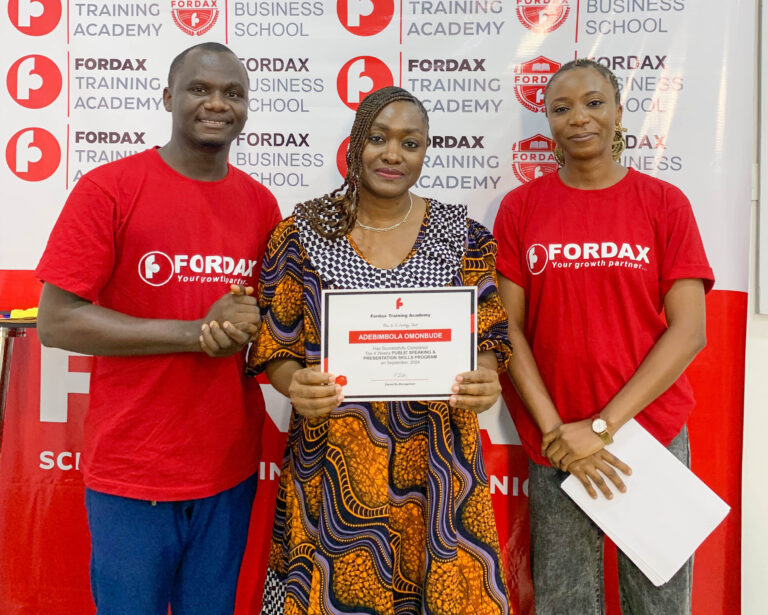
When academic departments adopt the Fordax Licensing Program, students do not simply attend casual meetings—they work through standardized tracks and earn recognized Fordax badges and certifications upon completion. If a graduate moves from Nairobi to Kigali or from Lagos to London for post-graduate work or employment, their credentials remain valid. They can also transition into regional Fordax professional chapters across the continent without starting their development over.
Furthermore, departments have the option to offer the club as an exclusive faculty benefit or structure it as an affordable, self-funding student initiative that covers operational materials and departmental events.
African higher education is evolving toward experiential, market-relevant outcomes. By introducing structured communication and financial literacy programs on campus, HODs, deans, and senior lecturers can transform their institutions into breeding grounds for world-class leaders, researchers, and entrepreneurs.