

The Fordax Public Speaking Club VS the Fordax Public Speaking Training? 5 things you should know now
The Fordax Public Speaking Club VS the Fordax Public Speaking Training? 5 things you should know now
A lot of people keep asking the same question: what exactly is the difference between the Fordax Public Speaking Club and the Fordax Public Speaking Training?
On the surface, they may seem similar because they both focus on helping people become better speakers. But once you look closely, you’ll see they serve very different purposes and are designed for different stages of a speaker’s journey.

The simplest way to understand it is this: the training teaches you how to speak, especially from basic to pro, while the club gives you a place to practice public speaking especially as someone who already learnt how to speak.
The Fordax Public Speaking Training is structured, guided, and beginner-friendly.
- It’s designed for people who want to learn public speaking from the ground up or improve in a clear, step-by-step way.
- During the training, you’re not left to figure things out on your own. There is guidance, coaching, and a clear learning path.
- You’re taught the fundamentals—how to overcome speaking fears and anxieties, organize your thoughts, how to deliver confidently, how to engage an audience, and more.
- It’s an immersive experience that runs over four weekends, typically on Saturdays and Sundays between 2–5 PM. By the end of it, participants don’t just “try” public speaking—they understand it.
- They also receive a professional certificate, which can be useful for career growth and credibility.
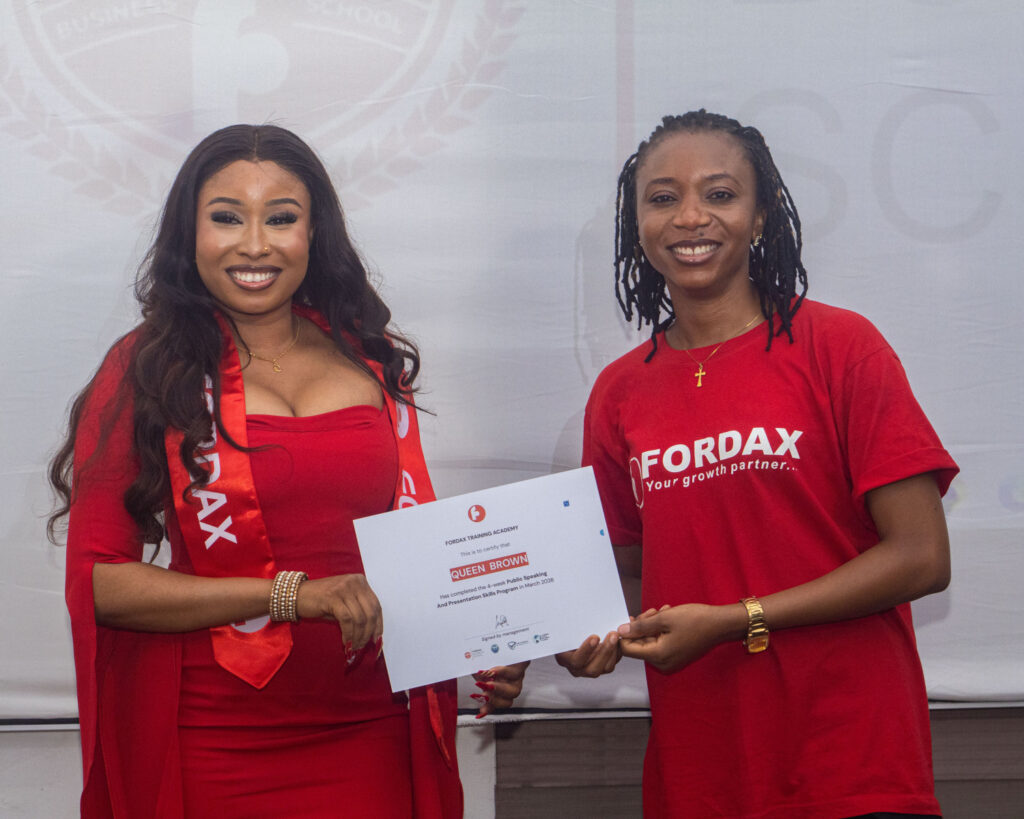
The club, on the other hand, is not about teaching from scratch.
- It’s about doing. It’s a practice environment. There are no structured lectures, no step-by-step teaching, and no hand holding. Instead, members show up, speak, and receive feedback.
- It’s a space where you sharpen your skills through repetition and real experience.
- The club runs on tracks, and each track can take a month or more to complete.
- Because of this pace, it can take several months—sometimes up to eight months or more—to cover what the training might deliver in just four weeks.
- Another key difference is recognition. In the training, participants earn a professional certificate at the end, which reflects a completed learning experience. In the club, members earn badges as they complete different tracks. These badges are more about progress within the community than formal certification.

The type of person each option is suited for also matters.
- The training is ideal for beginners or anyone who feels unsure about public speaking and wants proper guidance. It helps build confidence and provides a strong foundation.
- The club is better suited for people who already have some basic knowledge or experience—people who don’t need to be taught what to do, but need a space to keep doing it better.
There’s also a difference in how long each experience lasts.
- The training is time-bound. It runs for a few weekends and then ends.
- The club is ongoing. It’s built around community, consistency, and long-term growth. Members meet regularly, often every Saturday or at least twice a month depending on location. It becomes more than just a program—it becomes a network of people growing together.
Who Should Go for the Training and Who Should Join the Club?
Sometimes the easiest way to decide is to look at real-life situations.
If you’re like Tunde, who has a job interview coming up and struggles to express his thoughts clearly, the training is the better choice. Tunde needs guidance, structure, and someone to show him what to do step by step. Jumping straight into the club might overwhelm him because he hasn’t built the basics yet.
If you’re like Amaka, a business owner who avoids speaking at events because of stage fright, the training will also serve you well. You need a safe, guided environment where you can understand your fears and learn how to manage them before facing regular speaking sessions.
Now consider someone like David, who has attended a Fordax training before, understands the basics of public speaking, but feels rusty or inconsistent. The club is perfect for him. He doesn’t need to be taught everything again—he needs a space to practice regularly, get feedback, and stay sharp.
Or take Chioma, who has already gone through some form of public speaking training 3 months ago or so but lacks consistency due to busy schedules or whatever. She starts strong, then stops practicing. The club gives her that regular structure and community that keeps her accountable and improving over time.

Then there’s Musa, a professional who speaks occasionally at work but wants to become more confident and polished. If Musa feels he still lacks structure, he should start with the training. But if he already understands the basics and just needs more practice, the club will help him refine his delivery.
In simple terms, if you feel unsure, inexperienced, or need someone to guide you, go for the training.
If you already know the basics and just need to practice, improve, and stay consistent, the club is the better fit.

In the end, both the training and the club are valuable, but they serve different roles.
One builds the foundation, the other strengthens it. That’s why the training is usually recommended first. It prepares you properly, so when you step into the club, you’re not lost—you’re ready to practice, improve, and grow with confidence.
Hello Fordax Team,
Are these platforms, Fordax Speaking Club and Fordax Public Speaking Training available online for those who are not based in Abuja.
I am based in Asaba, Delta State.
Is these Speaking Club and Public Speaking Training available online.
Thanks i would like to get a feedback.
Yes they are. Please contact us for further details – 0912 650 7864
Hello Fordax Team,
Are these platforms, Fordax Speaking Club and Fordax Public Speaking Training available online for those who are not based in Abuja.
I am based in Asaba, Delta State.
Is these Speaking Club and Public Speaking Training available online.
I would be grateful for a feedback.
Yes they are. Please contact us for further details – 0912 650 7864
Ok